S&P, Newbuilding and Demolition Update (October 27th, 2013)

This isn’t the time to be shy!

Another week and another step toward a cyclical recovery in shipping!  No doubt!  At least that’s what the present market activity implies.  A year ago, even six months ago, it seems that there were some doubters about the recovery; for now, if there are any doubters, they are sure very low profile.

Let’s start with the newbuildings: this past week, it has been reported that Maersk Tankers has placed an order for ten (10) product tankers. The order is yet to be confirmed, but this is just another ‘massive’ order in the product tanker sector.  Navig8 Product Tankers also placed an order for four coated aframax tankers (LR2) at Guangzhou S.Y., at $48 mil apiece, and d’Amico another order for four handy products (MR1) at Hyundai Vinashin at a reported $31 mil each.  Approximately seventy (70) MR1 and MR2 tankers were ordered in each calendar 2011 and 2012, but year-to-date about 120 such vessels have been ordered.  As a matter of comparison, the world fleet of MR1 and MR2 tankers stands at approximately 1,425 double-hull vessels with 35,000 to 60,000 dwt and built after 2000 (with the outstanding orderbook at about 250 vessels.)

In the MR2 market still, it has been reported that the good vessel MT „ARISTARCHOS” (52,000 dwt, 2013, HMD) was sold at $38 mil, a definite step up on pricing in this market.  The more interesting point on this sale is that buyer and seller are other than Scorpio Tankers, the prime mover of this market in a while and active player in the resale market (besides their massive newbuilding program); there has been criticism in the past that Scorpio on purpose were paying up for resales to pull up the market, which would reflect favorably on their existing fleet and move (their original cost basis in this market is just below $33 mil per vessel.)  With the sale of MT „ARISTARCHOS” it seems that there is at least another buyer who does have conviction in the market; but again, we suspect that a higher price perhaps was justified for the vessel to be chartered to a premier credit oil company and then sail off to an MLP. In still same asset class, the pump-room design MT „WAWASAN CELESTE” (45,750 dwt, 2006, Minami Nippon) was reported sold to publicly traded Ardmore Shipping at $20.6 mil (vs. sale of sistership vessel in September of MT „TWINKLE EXPRESS” at $20 mil.)

And just to make it clear that asset prices are not just moving higher, but also on en bloc deal basis and on the back of funding form institutional investors and with a focus for the capital markets – whether Oslo or New York, Hafnia Tankers was successful at raising $235 mil from a private placement in Oslo, and promptly confirmed the purchase of ten product tankers from co-patriot J. Lauritzen.  The four LR2 tankers ordered by Navig8 Product Tankers – mentioned earlier, were on the back of a second private placement by the company in Oslo raising an additional $150 mil ($170 mil were raised during the first phase.)  Eletson Holdings (Kertsikoff) created a $700 million JV with Blackstone (Tactical Opportunities fund) and intend to place orders for eight semi-refrigerated gas tankers. And just in case one thinks that the US markets are playing second fiddle to Oslo, American Petroleum Tankers, a Jones Act Blackstone-sponsored tanker company has filed for an IPO with the SEC intending to raise about $170 million for the purpose of repaying debt.

On Sunday, the Financial Times reported on the private equity and institutional investors looking to invest in shipping; the transactions mentioned above are just the top line major transactions that register on the radar; there are several more transactions on smaller scale and on project basis acted upon institutional investors that are purposefully are kept off the radar.

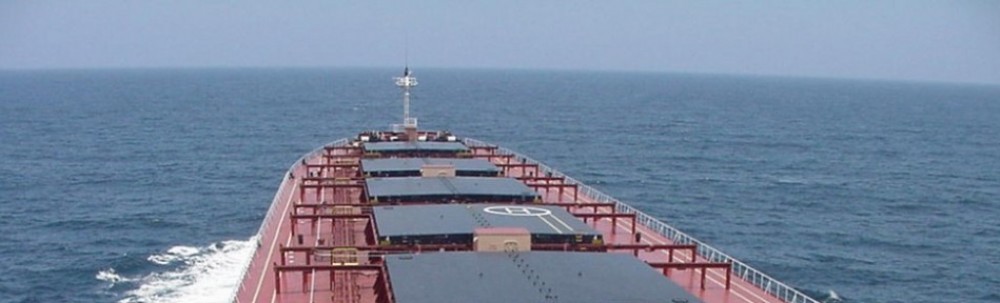
MV „BIG WAVE” - A vessel aptly named for our times

MV „BIG WAVE” – A vessel aptly named for our times

And, not to think that bulkers are falling behind, it has been reported that the capesize vessel MV „ATLANTIC BRIDGE” (177,000 dwt, 2005, Namura) was sold at $27 mil; it’s tough make an assessment on the ‘strength’ of the price as the buyers were also her charterers (Cargill International) where obviously information has been symmetrical, but the vessel was also on charter till 2015 at about $16,000 per diem (Cape FFA curve for CAL14 and CAL15 slightly above $17,000 pd.)  However, the panamax bulker MV „ENERGY ROSE” (70,000 dwt, 1997, Sanoyas) was sold to Greek buyers at just below $10 mil, a definite sign that the market for dry bulk is strengthening as well (please see our previous report for additional sales in this segment.)  There are also rumors that MV „HOUHENG 3” (180,000 dwt, 2012, HHIC-PHIL) is under firm negotiations at $52 mil, a very firm price (despite the continued softening in the cape freight market.)  The handysize bulker MV „VOGE FELIX”  (24,300, 1997, Hakodate) was sold at $6 mil, having failed last month at similar levels.  The bigger handy MV „TREMONIA” (28,100 dwt, 2001, Bohai) was sold at mid $7-mil-range, while her exact sistership MV „HIBERNIA” was sold last month at $7 mil, another solid sign of an improving market. And of course, players in the dry bulk market could not satisfy themselves with secondary market alone!  Alpha Tankers & Freighters of Greece has been rumored to have firmed an order for two high-spec capes at Hyundai Mipo with 2015/2016 deliveries at $56 mil, a definitely gutsy call in the cape market.  [However, this is one of the few Greek owners with really long-term view of the market, and in gesture of getting closer to strategic players in the market, the company established Pantheon Maritime Services in Singapore to commercially manage the fifteen-vessel-strong capesize fleet]. Fredriksen’s Frontline 2012 in the same market and expected delivery proceeded with an order of two capes at New Times at about $50 mil each.

No doubt that our summary report does not imply any signs of market depression, distress or navigating under ‘mackerel skies’.  But, as they say, things are great until they are not.

© 2013 Basil M Karatzas & Karatzas Marine Advisors & Co.  All Rights Reserved.

IMPORTANT DISCLAIMER:  Access to this blog signifies the reader’s irrevocable acceptance of this disclaimer and other important information and terms. No part of this blog can be reproduced by any means and under any circumstances, whatsoever, in whole or in part, without proper attribution or the consent of the copyright and trademark holders of this and related websites. Whilst every effort has been made to ensure that information herewithin has been received from sources believed to be reliable and believed to be accurate at the time of publishing, no warranties or assurances whatsoever are made in reference to accuracy or completeness of said information, and no liability whatsoever will be accepted for taking or failing to take any action upon any information contained in any part of this website.  Thank you kindly for your consideration.

How to Buy a Ship – A Typical S&P Transaction

For people who have never worked in shipping, the concept and the logistics of buying a vessel sounds mind-boggling.  How one buys a piece of property in some foreign jurisdiction that likely flies another jurisdiction’s flag and possibly could fly another flag once the sale is concluded, when the holding companies of the buyers and sellers may reside in yet other jurisdictions, the vessel likely is mortgaged by a creditor in a different jurisdiction and the mortgage has to be released so that a free title can be passed to the buyers?  How one can ensure that all details are attended to and the sale is smooth, and that the whole transaction does not end up in smoke once the buyers’ funds have reached the sellers’ account (buyers’ funds along with release of escrow deposit and other funds due have to reach sellers’ account before the sellers’ release the title.)  Buying real estate or a car may be a mini-version of a shipping transaction and things can go wrong, but at least with real estate, it’s absolutely clear that the property is stationary and in the event of dispute, the jurisdiction is abundantly clear.

For the purposes of this discussion, in our series of discussions on sale & purchase, we assume that this transaction is about the sale and purchase of a vessel in the secondary market, meaning that the vessel is already on the water and trading and the buyer intends to buy her as a trading vessel and immediately put her to work to transport cargo for profit.  Transactions for newbuilding contracts to shipbuilders or ‘resales’ (usually novation agreements for the sale of newbuilding contracts to a new buyer while vessel still on contract to be built or under construction) and transactions for the sale of vessels for scrapping (demolition sale) whether directly to the end buyer (a scrap yard) or to an intermediary ‘cash buyer’ are not considered under this scenario; such transactions are still handled by shipbrokers, but there are nuances in such transactions and their contracts that for now fall outside the scope of this essay.  Also, for the purposes of this discussion, we will not endeavor to analyze the logic of the seller and the buyer behind the transaction, only that these two parties, acting on their own will, without compulsion and in full knowledge of facts and market conditions, are willing and able to enter into such a transaction.

A typical S&P transaction starts when an operating shipowner (someone who operates / manages their own vessels (as compared to a financial shipowner)) contacts their shipbroker (or ‘S&P broker’) to inquire about a certain type of vessel, market conditions in terms of freight, market and employment prospects, recent transactions and prices, the parties involved in those transactions and the nature of the transactions (such as ‘charter free’ sale, or with ‘charter back’ or with ‘survey due’, with ‘prompt delivery’ or ‘subject to tender’, or ‘subject to financing’, etc.)  Likewise, for a potential seller, a similar phone call will be placed with the shipbroker of their choice inquiring about similar information.

Once our friendly owner decides to make a purchase, they will inquire about available tonnage for sale, that is for vessels whose owners have openly been advertising them for sale through the S&P broker market, or sometimes through trade publications, internet, etc.  For such available tonnage for sale, usually there is no exclusive broker handling a vessel and their owner is dependent on competitive brokers to find buyers.  In certain cases for openly availably tonnage, the seller may have engaged exclusively a third-party, competitive broker to source buyers, but usually the exclusive broker may be ‘in-house’ broker or works for a brokerage office affiliated with the sellers’ group of companies.  The buyers’ broker will also send a blast email (a ‘P/E’ or ‘purchase inquiry’ in brokerage parlance) to corresponding brokers worldwide looking for additional similar tonnage for sale, fitting the buyers’ guidelines of potential candidates in terms of size, age, builder, specification, etc.  At the age of the internet of instant and extremely cheap telecommunications and under the mode of ‘information wants to be free’, most sales candidates are already well known to players with decent market access and set of skills. Therefore, the main purpose of any purchase inquiry is to find vessels that are not actively in the market for sale, vessels that their owners may need some convincing to consider selling them, vessels that there are certain ‘buttons’ behind their ownership that if pressed could entice their own to sell them.  ‘Off market candidates’ are usually the holy grail of shipbrokerage, as these are the vessels that can be sold under certain circumstances but the market doesn’t know yet.

Once a certain sales candidate has been located and there is a general understanding overall ‘price ideas’ between buyer and seller, then the buyer, through the designated ‘broker channel’ would inquiry certain technical information about the vessel for their evaluation, such ‘class printouts’ (copies of the vessel’s maintenance and condition records with their classification society), permission to ‘sight class records’, ‘TC description’ (short for timecharter description, a two-page description of the vessel that usually the owners present to charterers with the vessels pertinent descriptive and commercial information such as cargo capacity, fuel consumption, etc), ‘GA Plans’ (short of General Arrangement plans, a overall arrangement of the vessel), ‘Capacity Plans’ (showing cargo holds or cargo tanks, their arrangement including loading / discharging mechanisms, and mostly their capacity), ‘Mid-section Plan’ (showing a mid-section, vertical cutoff for the vessel), the ‘Q88’ (for tankers, short of Questionnaire 88) and OCIMF report (for tankers, short for Oil Companies International Marine Forum).  Once the information provided is met with buyers’ approval, then buyers will ask for ‘permission to inspect’, that is, they will engage an inspector to visit and inspect the vessel.  Usually, there is an LOI involved (‘Letter of Indemnity’ that the inspector / inspecting party indemnifies and holds harmless the owners for any damage or accidents), and the inspector in the course of several hours will undertake a superficial, pre-purchase inspection of the vessel, meaning that without interfering with vessel operations and without having the right to open up the engine or any other parts of the vessel for inspection, the inspector is allowed to sight, inspect, copy and take pictures of the vessel certificates onboard, engine room, hotel accommodations (‘superstructure’), cargo holds / tanks, hull, ballast tanks, etc, observe cargo operations and take notes.  Inspecting a huge structure like a ship, while she usually undertakes cargo operations (loading / discharging) under tight time constraints, sometimes without natural light and often in dangerous or heavily contained spaces, it’s an art and a skill that often goes under-appreciated; not to mention the stakes that are tied to an inspector’s report.

About a week after the inspection, once the inspector had the opportunity to return to their office and put all the information they collected into a multi-page inspection report, the buyer now has a fairly accurate knowledge of the condition of the vessel, upon which they will base their exact opening ‘firm offer’ to the sellers.  The opening offer, contains not only a pecuniary offer for the vessel, but also the ‘main terms and conditions’ for the sale, such as contemplated time and place of delivery, items to be included in the sale, expected protocol, etc, to which the sellers will provide a counter offer about the price and the terms, and items that have to be excluded from the sale (usually rented items such as nitrogen bottles onboard are not the sellers’ property so they have to be excluded from the sale, but the buyer may opt to take over the rental contract to keep them onboard).  After a few turns of offering and counteroffering (fascinating ‘horse trading’ ritual this has been called from parties typically associated with shipping), there is hopefully an agreement on all terms, and then there is a ‘main recap’ where a clean email copy of the main terms of proposed sale is prepared and agreement is confirmed once again by both buyer and seller, as this agreement now has the full force of a legal contract.

NSF 93 - Sample First Page

NSF 93 – Sample First Page

Once the main terms / recap has been confirmed, it’s now the buyers’ broker job to incorporate such terms into a contract to be signed by both parties.  For the contract, there are certain boilerplate templates that have been used before; usually, the original ‘firm offer’ is based on such a template and one of the main terms of the recap specifically mentions the template to be used for the contract.  The most established form of template or MOA (‘Memorandum of Agreement’) is the ‘NSF 93’ form, short of the Norwegian Sale Form of 1993 which was prepared by the the Norwegian Shipbrokers’ Association and maintained by the Baltic and International and Maritime Council (BIMCO).  There is the updated ‘NSF 2012’ form, but NSF 93 has been the most popular template, as people are more familiar with it, and also there is a sizeable body of case law based on the older template.  Alternatives to NSF have been the ‘Nippon Sale Form’ which is preferred by Japanese sellers and usually considered a seller-friendlier template (as usually Japanese owners only sell in the second-hand market the vessels they built brand-new at Japanese shipyards), and the ‘Singapore Ship Sale Form 2011’ which is more commercially flexible to accommodate more legal jurisdictions (besides English Law) also the concerns of non-operating shipowners (like leasing companies, etc) who are getting a ever increasing slice of the shipowning pie.  Once again NSF 93 is the industry standard despite her age…

Once the MOA is prepared by the buyer’s broker, and reviewed once again thoroughly for any errors or omissions against the ‘recap’ and its main terms, then the buyers’ authorized representative first signs an original, to be exchanged by email or facsimile, and countersigned by the sellers’ authorized representative.  Once the MOA has been signed by both parties, still there is lots of work to be done until the delivery of the vessel.  However, the most difficult parts of the ‘deal’ are already done with, and now it’s time for buyers to ‘lodge deposit’ usually within three banking days for the sale and look forward to the day of the closing.

© 2013 Basil M Karatzas & Karatzas Marine Advisors & Co.  All Rights Reserved.

IMPORTANT DISCLAIMER:  Access to this blog signifies the reader’s irrevocable acceptance of this disclaimer and other important information and terms. No part of this blog can be reproduced by any means and under any circumstances, whatsoever, in whole or in part, without proper attribution or the consent of the copyright and trademark holders of this and related websites. Whilst every effort has been made to ensure that information herewithin has been received from sources believed to be reliable and believed to be accurate at the time of publishing, no warranties or assurances whatsoever are made in reference to accuracy or completeness of said information, and no liability whatsoever will be accepted for taking or failing to take any action upon any information contained in any part of this website.  Thank you kindly for your consideration.
S&P, Newbuilding and Demolition Update (October 20th, 2013)

A relatively quiet week not only for the US government but also for the shipping markets; probably a breather was necessary after the active schedule of the last few weeks.  Dry bulk freight markets softened marginally for the week, but freight rates have remained comfortably in cash flow positive territory for most types of vessels.  For instance, cape rates worldwide averaged about $32,000 pd for the week, with about $40,000 pd for the Brazil-China front leg.  VLCC rates have shown some improvement on increased fixing activity as 132 fixtures have been recorded for the October schedule, an annual high watermark. With China surpassing the USA as the biggest oil importer in September, IEA’s forecast that China’s oil needs will increase by 3.7% in 2014, owners wish to believe that such trade will allow for greater ton-mile and opportunities for triangulation (from cargoes from West Africa.) On the increase of domestic production of (light) crude in the US, W Africa imports of light crude to the US have been low which has caused Suezmax rates to take another dive reaching $6,000 pd. Some of the Suezmax tankers chasing this market were bought post-Lehman at close to $70 million.  Product tanker rates for both clean and dirty tonnage also softened, especially the USG-UK/Cont ‘backhaul’ trade of diesel.

In the tanker market, the most remarkable transaction of the week has been the sale of the LR1 tanker MT „LR REGULUS” (70,000 DWT, 2004, Daewoo) at $21 mil, which is in-line over ‘last done’ in September on the sale of MT „ANGEL 66” (71,000, 2005, Universal); both vessels are trading dirty, but „REGULUS” is with 81,000 cbm tanks, 12 tanks, 14 pumps and heat exchangers, vs. „ANGEL” with 77,000 cbm cargo tanks, 12 tanks, 3 pumps and no heat exchangers.  The Teekay-controlled small sisterships MR tankers MT „CITRON” and MT „CITRUS”  (47,000 DWT, 2007/2008, Hyundai Mipo Dockyards) have been sold to US-based Diamond S Shipping (with bareboat back for six months) at $54 million. Given the narrowing of the gap between LR1 and MR2 tanker pricing, and given that an LR1 holds about 30,000 tons of additional cargo over an MR2, one has to wonder whether an arbitrage opportunity has been created in this market.

In the dry bulk market, the Dolphin 57 design, modern supramax vessels MV „GUOYU 51” and MV „ORIENTAL TRADER” (57,000 DWT, 2011/2012, Yangzhou Guoyu, 4x30T cranes) were sold to Greek buyers (funded by US-based institutional investors) at appr. $41 mil.  In general, dry bulk assets prices have shown 10%+ improvement over the last month; as a result, we have seen more activity in the market for vessels to be sold from shipbuilders or owners who have placed orders in the last year and now are trying to exploit the recent boom / activity and ‘cash out’.  We are not sure whether these are signs of little faith in this market recovery, or abiding by the adage that ‘no-one went broke by taken profits’. For instance, eco-design Chinese resales for kamsarmax tonnage is being shopped at the $27 million range where there is a $2-3 million profit for the sellers; given that the deposit may have been 20% of the contract price, the above mentioned capital gain can translate into a well-in-the-double-digit-return territory.

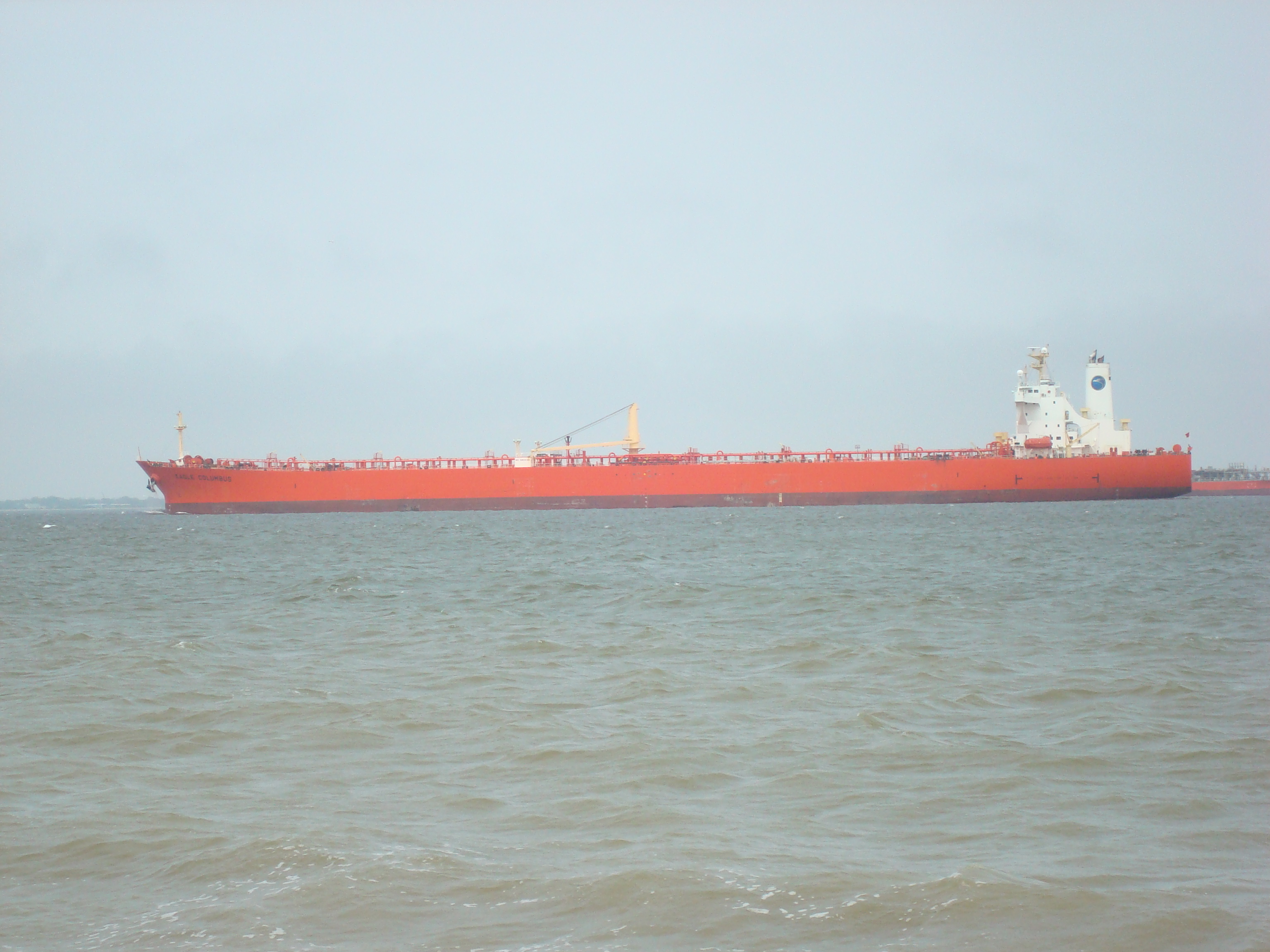
Aframax Tanker MT „EAGLE COLUMBUS" (Image Source: © Karatzas Marine Advisors & Co.)

Aframax Tanker MT „EAGLE COLUMBUS” (Image Source: © Karatzas Marine Advisors & Co.)

In the demolition market, there has been an ever-increasing improvement in pricing as well.  Despite the Eid Holidays in the sub-continent, pricing for tankers has moved to $430-435/ldt range, an impressive improvement given than in August tankers were fetching $380-390/ldt.  Still, there have been major concerns that cash buyers have been optimistic on their own account, without often having secured end buyers, a potentially risky situation that could result in many defaults if end buyers do not come to share the cash buyers’ optimism. Dry bulk vessels are fetching about $20/ldt less than tankers at about $415-420/ldt, and the price differential between the Chinese and sub-continent demolition markets has started yawning again, reaching about $80/ldt.  The most noteworthy demolition transaction of the week has been the sale of two sistership aframax tankers built in 1993/1994; the vessels were sold on ‘as is, where is’ basis, delivery Labuan, at about $405/ldt with about 15,950 ldt/vessel.  The vessels were controlled by US-based fund, despite their ‘misleading’ naming MT „EAGLE CORONA” and MT „EAGLE CARINA”, as they were subject to a sale-and-lease back transaction in the summer of 2008 at $42 million each.

© 2013 Basil M Karatzas & Karatzas Marine Advisors & Co.  All Rights Reserved.

IMPORTANT DISCLAIMER:  Access to this blog signifies the reader’s irrevocable acceptance of this disclaimer and other important information and terms. No part of this blog can be reproduced by any means and under any circumstances, whatsoever, in whole or in part, without proper attribution or the consent of the copyright and trademark holders of this and related websites. Whilst every effort has been made to ensure that information herewithin has been received from sources believed to be reliable and believed to be accurate at the time of publishing, no warranties or assurances whatsoever are made in reference to accuracy or completeness of said information, and no liability whatsoever will be accepted for taking or failing to take any action upon any information contained in any part of this website.  Thank you kindly for your consideration.

S&P, Newbuilding and Demolition Update (October 13th, 2013)

The decline of freight rates and of the BDI notwithstanding later in the week, hope springs eternal that shipping is at the first stages of a cyclical recovery.  It’s to be seen at which phase of the cycle we are in, but for now let’s all enjoy what the market brings!

The momentum continues in many markets, capital markets and private markets, and the volume of sale & purchase transactions has been rather robust; also, asset prices have been showing signs of improvement (please see our last report on capes from last week), or at the very very least, holding steady.

For tankers, ‘year of built’ 2000 has become a psychological barrier, with tankers built prior to that getting stigmatized definitely as “bad” (read, priced at scrap-related levels), anything built after 2000 but newer than ten years seen as “ugly” (for the sellers that is, but rather fertile for a ‘value-deal’ for the buyers, in our opinion), and anything newer than ten years perceived as “good”.  And if one is in need to differentiate further, vessels on order are the best (“pretty ladies”, as the saying goes.)

The pumproon-design product tanker MT „UNIQUE SUNSHINE”  (47,000 dwt, 2001, Onomichi) was sold at $12 mil to Greek interests (“ugly”), while slightly smaller but newer MT „PIONEER SUNSHINE” (46,000 dwt, 2004, Shin Kurushima) was sold to Greek interests, again, at $17 mil (“good”). There has been definite price improvement (and robust activity) over the last few months for this asset class, as in May the good vessel MR „HALLINDEN” (46,000 dwt, 2008, Shin Kurushima) was sold at just excess of $20 mil to Greek interests, again.   Four modern, high quality aframax tankers (but of narrow beam) built at Sasebo H.I. in 2007 & 2008 were sold from clients of Cido Shipping (Japan) to Zodiac Maritime (Singapore) on private terms, at a price rumored to be about $104 million (between $25-27 mil per vessel); with about $52 million replacement cost, this is a “very ugly” transaction despite the age and pedigree of the vessels, but we suspect there is more to it than it meets the eye, given the nature of the buyers and sellers.  And, speaking of “very ugly” transactions, the Daewoo-built in 2003 VLCC MT „BW LUNA” was sold to an active recently Indonesian buyer, Soechi Lines, at $36 mil (as a matter of comparison, less than four years ago, such vintage vessels were well in excess of $50 mil).  However, there has been improvement given that a sistership vessel MT „BW LUCK” was sold at $35 mil earlier in the summer. The theme with crude oil tankers these days is that their market is so bad that it cannot get any worse (“don’t get no respect!” in the immortal words of Rodney Dangerfiled), which is a nice and soothing line, but not a great investment thesis…so, we have been a bit surprised by the rumors that a major VLCC fleet acquisition may be in the works based on the logic that …things in the crude tanker market cannot get worse… try to keep this mind (and a long balance of working capital to maintain the position)… but things, otherwise, like will not get worse.

The dry bulk market with its longer tail of charterers and more flexible standards overall (compared to tankers) has been active too, with Japanese-built resales of Kamsarmax tonnage committed to Greek buyers in excess of $31 mil. The fifteen-year old MV „ORIENTAL SUN” Japanese-built panamax bulker was sold just below $11 million, while the ten-year old MV „SEA OF GRACIA” panamax built in Japan was sold at just below $17 million (in en bloc deal with MV „SEA OF HARMONY”; we understand that the vessels were no exact sisterships.) And, in the ever surprising cape market, the 1997-built at IHI in Japan cape MV „SU-OH” was committed at $16.5 million.  The “ugly” bunch in this market may have more wind in their sails by virtue of the nature of their trade.

The showstopper however has been the newbuilding market where, honestly, we have lost count of newbuidings recently; just the broader news, Scorpio Bulkers (SALT) has announced orders in the magnitude of $400 million, and a reference name Greek owner cape / VLOC orders in excess of $1 billion. A few more orders for several MRs from Navig8, several post-panamax 10,000 TEU containerships (ULCVs), a few more Newcastlemax orders by the Oldendorff Group in Germany, etc, etc  We understand that most S. Korean and good quality Chinese yards are solidly booked till end of 2016, and several Japanese builders have managed to pick up orders from international buyers over the last six months.

World Economic Growth Revisions (Graphs from the Financial Times, Oct 8, 2013)

World Economic Growth Revisions (Graphs from the Financial Times, Oct 8, 2013)

For someone having tangential knowledge of shipping, the active orderbook would imply that things in shipping are great.

However, just last week, the IMF lowered forecasts for economic growth in 2012 to 2.9% (the lowest post-crisis) and 3.6% in 2014 on ‘subdued medium-term growth trajectory’ expectations. And, for September, Chinese exports dropped unexpectedly by 0.3% year-over-year against expectations of 6% growth, it was announced by the Customs Administration over the weekend.

Full steam ahead! 2008, here we come again in a boatload of newbuilding orders!

© 2013 Basil M Karatzas & Karatzas Marine Advisors & Co.

No part of this blog can be reproduced by any means and under any circumstances, whatsoever, in whole or in part, without proper attribution or the consent of the copyright and trademark holders.

A Ship Called MT „AROSA”

There has been an almost continuous series of headlines recently with eulogies for the death of early generation double-hull tankers, especially VLCCs.  No doubt that freight rates are low, and no doubt that asset prices have dropped by about 50% for this type of vessels in 2011.  But again, not all news is bad, and shipping life can be as spicy as some of the Captain’s exotic port calls!

In 1993, the shipping company Neda Maritime of the Lykiardopulo Group received delivery of the good vessel MT ‘AROSA’, the second ever built double-hulled VLCC (291,000 DWT ordered at Hitachi Zosen in Japan.)  At that time, double hull vessels were still an avant-garde in shipping, without any record of expected commercial history or technical behavior, but mandated by OPA 90 and the Exxon Valdez accident.  At that time, newbuilding prices were in the low $90’s million, but the Lykiardopulo Group has had a reputation of building floating temples to the shipping gods, so the cost for this vessel was reported at the time at just below $100 million (nominal prices).  Just a few weeks ago, the very same vessel under the same name and still under same ownership was sold to Thai interests at about $24 million for conversion to floating storage; similar vintage vessels had the unfortunate fate recently to face the ship breakers’ torch at a salvage price of around $20 million.

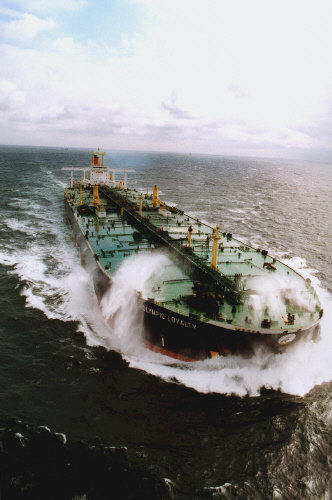
VLCC „OLYMPIC LOYALTY"

VLCC „OLYMPIC LOYALTY”

If we were to assume that the vessel at her delivery was financed with standard terms of first preferred mortgage of about 60% leverage and eight year tenor at 6% annual interest, and employed on continuous one-year time charters (average rate over the last twenty years of about $35,000 per diem) and 95% utilization rate, and all other standard industry practices, the vessel would have generated less than 15% return for her owners, until her sale.  Not bad returns at all for such a shipping project, given that the vessel had to trade in the weak freight markets of late 1990’s and the first early years of this century, and of course the abysmal rates of the last couple of years.

It seems that despite the weak freight markets of recent and precipitous decline of asset prices, still long-term projects in shipping can be profitable on an operating basis if approached correctly: a good, traditional owner orders a high quality vessel from a good yard and trades the vessel through the cycles.  No ambitions of a) correctly timing the market, b) investing with a three-to-five year investment horizon (unlike some financial owners), c) utilizing the best financial engineering available or d) making money by building ‘cheap’ vessels.  So far, so good.

As it’s the case with the shipping industry, there are often other aspects that make an interesting story even more exciting.  The calculations above are based on the assumption that the vessel was at all times employed at one-year rolling timecharters at prevailing rates.  In reality, there is at least one instance when this good vessel was fixed on the spot market to ExxonMobil in 2004 for a voyage from Middle East to Japan at about $230,000 per diem, or gross freight revenue of about $30 million; that’s proceeds from just one trip alone!  And, sure there were a few similar equally profitable trades during her career.  Thus, the IRR numbers above are good enough for forensic analysis without providing all the excitement and profits of the actual trading.

And, to reach deeply in the spice cabinet now, there have been rumors that at the top of the market, in early 2008, the owners had received offers for the sale of the vessel at $110 million, but such an offer at the time was deemed to be on the low side and was duly rejected.  That’s true: a vessel delivered in 1993 at a cost of less than $100 million, fifteen years later was obtaining offers in excess of her (nominal) construction cost (that’s the nature of shipping!) In retrospect, that would had been an ideal trade: cashing out on the vessel then at the absolute top of the market having ‘made a killing’ in the super-charged years of the super-cycle (2004-2008) and sell just before the dive to the bottoms of the abyss.  But again, hindsight is always perfect.

In the Captain’s judgment, the moral of the story is that market timing for asset play in shipping always delivers ‘home runs’ in big ways, but cannot be reliably depended upon to deliver ordinary returns; even traditional owners with a ‘nose’ for market timing sometimes miss a call.  But, market timing can deliver extra-ordinary returns! And, just because a vessel is sold in a bad market at a ‘perceived’ weak price, it doesn’t necessarily mean that the owner lost money on the investment or they didn’t make money!  Quite the opposite!  The owner could have made money still having left a lot of money on the table!

And a question to keep one up at night, whether for philosophical or commercial reasons: imagine the poor soul who made the offer to buy the vessel at the top of the market at the now exorbitant price of $110 million and the offer was rejected!  What would have happened today if they had bought the vessel?  How the investment return numbers above would look like?  Probably instead of profit, the very same sale price might have looked like the ‘haircut’ of the century!

Was it luck? Was it karma?  Was it greed?  Was it perspicacity?

This article was originally posted on December 27, 2011 at the Ship’s Log blog. 

© 2013 Basil M Karatzas & Karatzas Marine Advisors & Co.

No part of this blog can be reproduced by any means and under any circumstances, whatsoever, in whole or in part, without proper attribution or the consent of the copyright and trademark holders.