
S&P Monthly Review, September 2013

September is always an interesting month, not because of the nostalgic memories of the beach and the summer vacation but mainly because it sets the tone for the all important final quarter of the year, the momentum and the expected deal volume to be closed by the end of the year.

Freight rates in September were dominated by an exceptional increase for freight for capesize vessels caused by increased Chinese imports of iron ore.  There have been a) no clear documentation yet as to the real cause (whether increased end demand for steel or more innocuously by stockpiling of steel plate or iron ore) and b) whether the trend is sustainable. In a previous posting, we maintained a certain degree of skepticism on this market; however, despite the fact that cape rates increased and pulled upwards the overall dry bulk index (as per chart herebelow), panamax, supramax and handysize vessels didn’t share much of cascading benefit.

Baltic Exchange dry indices (Summer 2013)

The tanker markets, whether crude or products and chemicals, had overall a very un-inspiring summer; clearly chemical tankers and products, especially for clean, performed better; gas tankers also have been showing a more animated performance.  The chart herebelow with the two main Baltic Exchange tanker indices does not capture the whole picture, as crude oil tankers in certain markets, and especially VLCCs in particluar, are barely covering vessel daily operating expenses, again.

Baltic Exchange tanker indices (Summer 2013)

Despite the very concentrated freight improvement (capes), the overall momentum in the market has been very positive, much more positive than reality justifies, in our opinion.  There have been talks that the market has turned, the worst is behind us (including Maersk’s main point during their investor day recently), and that now it’s time to grow by aggressively going after deals.  In September, there have been announcements for several secondary offerings in the US (Scorpio, Tsakos, Boxships, etc), the Norwegian over-the-counter market kept maintaining its strong momentum, and several private equity funds and institutional investors – primarily from the US, have started getting more engaged with shipping and actually committing funds.  News from a couple of recent trade conferences have been brighter than expected, but it has to be said that the tone at shipping conferences is set by mostly the sell-side and the intermediaries (and as Warren Buffett has already mentioned, you don’t ask your barber whether you need a haircut.)

Following on our last monthly report, we have incorporated data from the last three trailing months in 2013 for this end-of-September report, and also for the same timeframe of the last year, in order to give a better perspective; after all, comparing September volumes to August’s is not a fair argument due to seasonality.

S&P Sales (Summer 2013)

We have counted the sale of 84 vessels in the secondary market for dry bulk vessels, containerships, gas tankers, chemical and products, and crude tankers in September 2013. The volume is comparable to that in the previous month (Aug 2013: 90 sales) and also over the last year (Sep 2012: 80 sales.)  However, August this year had been unusually busy (90 sales vs only 50 sales in Aug 2012), and the overall result has been that July-Aug-Sept in 2013 were busier for the secondary market with 237 sales vs. 190 sales in the same period last year.

S&P Sales (Summer 2012)

The demolition market for September has been fairly anemic with the sale of 50 vessels which is about 15% lower m-o-m. This is not breaking news, as the ‘de-coupling’ effect of the emerging markets from the Fed’s announcement of tapering off for bond buying had a major casualty in sub-continent currencies and especially for the Indian Rupee (INR), major currency in the demo market, which visited the lowest FX point in about fifteen years. The appointment of MIT-educated, University of Chicago professor Raghuram Rajan as the new Governor of the Reserve Bank of India and his prompt reaction of increasing interest rates as well as the Fed’s decision to temporize the tapering off of the quantitative easing (QE) has brought has stability in the markets and local currencies, and there have been some signs of market improvement by the end of the month.

Demolition Sales (Summer 2013)

The de-coupling effect aside, the positive momentum in the freight markets has given second thoughts to many owners pondering whether they should be selling their vintage vessels for scrap. Scrapping prices have improved substantially over the month of September, primarily due to lack of demolition candidate vessels; there are concerns that there has been exuberant speculation in the market and higher expectations for defaults, as ‘cash buyers’ may be bidding up prices, but they are not the end buyers; they take market risk, and a great deal of them do not have the balance sheet to handle such risk, so caveat emptor. In general, scrap prices for tankers in sub-continent have nominally improved from $370/ldt to $420/ldt, an almost 15% increase in a short month, when there are no really assurances that the end market has improved equitably.

Demolition Sales (Summer 2012)

The take home message from the demolition market is that in Jul-Aug-Sep 2013, 177 vessels were sold for scrap, vs. 235 vessels that were sold for scrap in the same period year, a decrease in scrapping volume by about 25%. A fairly substantial point, if one is ever to hope for market recovery caused by decreased tonnage capacity.

Further to the market recovery and tonnage capacity, 87 vessels were ordered in September 2013, almost identical amount compared to the month before, but almost 75% improvement y-o-y (50 orders in September 2012.)  All in all, in Jul-Aug-Sep 2013, 272 vessels were ordered versus 170 vessels in the same period last year, an improvement of 60%; in terms of net numbers, one hundred more vessels were ordered during than demolished during this period, a monthly average addition of thirty vessels to the world fleet.

Newbuilding Contracts (Summer 2013)

Newbuilding Contracts (Summer 2012)

Where is that damn market recovery?

For more inspiring thinking, probably a set like in the picture below offers a more promising prospect than chasing shipping statistics…

Beach (Malvides)
Beach (Malvides)

© 2013 Basil M Karatzas & Karatzas Marine Advisors & Co.

No part of this blog can be reproduced by any means and under any circumstances, whatsoever, in whole or in part, without proper attribution or the consent of the copyright and trademark holders.
What’s Sale & Purchase (‘S&P’) in Shipping?

What does ‘S&P’ stand for in the shipping industry?  It definitely doesn’t stand for Standard & Poor’s, although a few shipping companies have been aspiring to be part of the well-respected ‘S&P 500’ index.  It doesn’t stand for ‘Salt and Pepper’, although sailors and the Navy are dressed seasonally in Summer Blue (“Salt and Pepper”.)  It doesn’t stand for Shipping & Processing, even evocatively, although we are still talking about the shipping industry.  It doesn’t stand for Standards & Practices applied in the broadcasting industry, Standards and Protocols or Security and Privacy used in the computer science, Sensation and Perception in psychology, Subcontract and Procurement in workflow analysis, or Strategy and Policy used in consulting and business analysis.

It simply stands for Sale & Purchase (S&P), the business practice of buying and selling commercial ships in the open market.  As grandiose ships as they may look, there is a need for their brokerage, whether as newbuilding contracts to be ordered at the shipbuilders when they first are getting built, or as ‘used’ vessels in the secondary market, or finally as old vessels now are destined sale for scrapping (demolition.) The professionals who are brokering the vessels are called ship brokers (or S&P brokers,) and are offering different services from charter brokers (who are brokering the freight / employment for the vessels but not the vessels themselves; brokers focusing on the tanker market are called tanker brokers.)

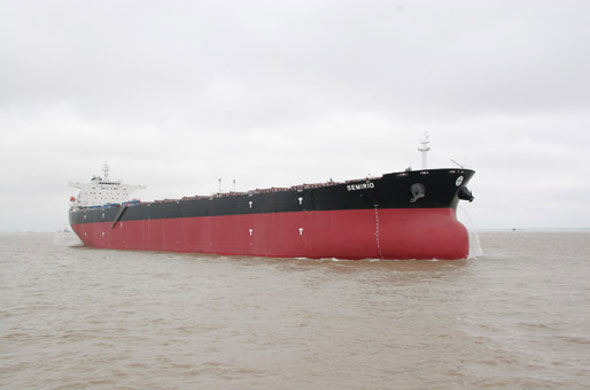
Capesize Vessel

Capesize Vessel

S&P brokers, much like real estate agents, do not hold any inventory on their balance sheets, that is that they do not own the vessels they sell; they just sell other people’s vessels to buyers without actually undertaking any risk at all (besides the time and effort they put into a transaction) or making any capital commitment in the transaction.  As such, the barriers to enter the industry are relatively low, and when times are good, there are many entrants, a great deal of which will wash out during the next market trough.  As great as this may be for most of the time for the principals (shipowners) looking to buy or sell vessels, since brokers usually provide liquidity, efficiency and, yes, more transparency than otherwise in the market, it’s not always an accretive situation for the market and its interests; low barriers mean that jetsam and flotsam enters and leaves the market depending on whether quick buck can be made without necessarily contributing value to the market.

S&P brokers may specialize in certain market segments by asset class such as dry bulk vessels or containerships  or tankers, of gas carriers, etc; they may specialize in certain geographic markets dealing with clients or types of vessels in certain ‘contained’ markets such as vessels in the cabotage business or customized vessels for a certain trade such as mini-bulkers or shallow draft vessels, etc; ship brokers may also specialize by function such as focus on newbuilding vessels or scrap brokers – there are distinct intricacies dealing with a newbuilding contract to a shipbuilding yard where financing and technical details for a vessel expected to be market competitive for the next twenty-five years are extremely vs. selling a vessel by the pound (actually by lightship deadweight tonnage (ldt)) for her last voyage of no return to the scrap pile.  There are specialist ship brokers who have been working with clients lacking shipping market expertise, such as leasing companies or equity investors or lenders, who have to depend on proven track-records of solid experience and dedication at accessing not only top notch ship brokerage services but also hands-on expertise and logistical support (since unlike an operating shipowner cannot depend on in-house expertise.) Finally, ship brokers can be ‘competitive’ brokers offering their services to any potential buyer or seller, while there are also ‘in-house’ brokers who work exclusive for a ship owner (usually larger or active shipowners who trade fairly often and need in-house, dedicated expertise which they can control.)

What are the services that ship brokers usually offer in their regular course of their business?  The short, sweet answer is that they ‘broker ships’ between buyers and sellers and make a commission from the sale; that’s life and destiny for most of the ship brokers and fulfillment of many dreams. The degree of competence and success increases exponentially with access to market information in general, and information about the vessels themselves, their owners, the circumstances of the transaction, their skill and dedication to negotiate great price for their client (above-market-level price for a seller, below-market-level price for a buyer), and can follow up the documentation and closing of the transaction in a professional and competent level.

Ship brokerage, is a great and value-added service to the maritime industry. Selecting a ship broker to do business with is more complicated, but often, one of the most rewarding professional relationships that can be built!  A great deal of shipowners started out as shipbrokers. And another great deal of shipowners make fortunes based on the dedicate work and advise of their brokers…

© 2013 Basil M Karatzas & Karatzas Marine Advisors & Co.

No part of this blog can be reproduced by any means and under any circumstances, whatsoever, in whole or in part, without proper attribution or the consent of the copyright and trademark holders.

S&P, Newbuilding and Demolition Update (September 30th, 2013)

Cape Asset Pricing Improvement, for now
The capesize market had a terrific last two months with freight rates briefly passing $40,000 pd recently for an eye-catching improvement of almost 300%.  As phenomenal such rates as they may be, one may even call them a ‘fantastic object’ as legendary investor George Soros would say, unreal but immensely attractive; besides the obvious question on whether the freight rally is sustainable, there have been anxious inquiries on the impact of the rally on asset pricing, especially for modern capesize vessels.We understand that the 2013-built at IHI (now called Japan Marine United after the recent merger with Universal Shipbuilding Corporation) 180,000 DWT capesize vessel MV „CAPE CHALLENGER 1” was sold last week at about $51 million. Although the owner of the vessel was a Japanese local company, we understand that the sale was controlled by Mitsubishi Corp as the Sogo Shosha. There are conflicting reports on the buyers, ranging from private Greek owners (Carras Hellas) to the publicly traded Navios Group (if the buyer is a publicly traded company we are sure to have the obligatory PR in due course.)  Also this week, the 2013-built at Hyundai Heavy (HHI) 173,000 DWT capesize vessel MV „JK PIONEER” has been reported sold, possibly to clients of Diana Shipping (DSX) at a reported price of $52-53 million. Sellers are Korean-based JK Maritime, and the solid price is partially attributable to ‘eco design’ of the vessel and very good ‘spec’ despite the below market charter-attached of about $11,500 pd for six more months (which, if true, would impacted negatively the price.)

Big Cape Docking (Image Source: Vale)

Big Cape Docking (Image Source: Vale)

These two sales indicate substantial improvement for modern cape pricing over the last few months based on a market comparison analysis. About a month ago, Belgium-based Bocimar (Compagnie Maritime Belge) sold their 2012-built by Hanjin Subic in the Philippines MV „BULK CANADA” at $41.5 million to Norway’s Berge Bulk; given the perceived ‘weak’ name of the shipbuilder in the marketplace, some discount is attributable to such fact. Shortly before that, in late July, Jinhai Heavy Industries-built / controlled 179,000-dwt Hull No J0021 with 2013 expected delivery was sold at a reported price of $38 million to reportedly Greek interests (possibly, Marmaras Navigation.) This vessel had been ordered in 2010, based on information from market reports at the time, on behalf of Fredriksen’s Golden Ocean concern with an expected April 2012 delivery, but accurate details of full-fledged newbuilding contract details, such as refund guarantees, down payment, etc are thin at least. In any event, both these older sales deserve a downward adjustment of a couple of millions due to their shipbuilding pedigree and the potential lack of any extra TLC provided during their construction; and, both of the current sales came from high quality yards and seem to be of good specification, at least of specification not seeing in the market that often from sale candidates.

Based on these sales, there has been an asset appreciation in play to the tune of probably more than 25% over the last two months (when adjusting for age, spec, quality of parties involved, reputation of shipbuilders, etc)  No bad for two months’ time, especially after the misery of the markets in 1H2013; and, again, freight improved by ten times as much in almost the same interval.  Based on our discussions with market players, we understand that several modern capesize owners were approached about the possibility of selling vessels, providing another sign that the sentiment, at least temporarily, has improved and underlying the ever stated argument that there are no good vessels for sale.

It will be interesting seeing how the market will develop, and whether the present developments in the cape S&P market are indeed signs of a cyclical recovery or just another ‘false positive’ temporary peak.  At least for the immediate future, the market is widely expected to take a breather with Golden Week underway in China – the mother of the cape market; also, the paper market (FFAs) have not softened in the last two weeks despite the improvement of the spot market (CAL 14, CAL 15 and CAL 16 trade at about $17,000 pd,) well below the spot market, although the paper markets in shipping often trade in backwardation.  And the drop over the last two weeks for HRC steel has dropped by $20/ton squeezing the margins for the steel mills.

© 2013 Basil M Karatzas & Karatzas Marine Advisors & Co.

No part of this blog can be reproduced by any means and under any circumstances, whatsoever, in whole or in part, without proper attribution or the consent of the copyright and trademark holders.

Is the crude oil tanker market dead?

The dry bulk market seems to be bouncing along, the containership market has been trading sideways, the product tanker market seems to keep attracting ever more attention on the back of the shale oil developments in the US and the bringing online of refineries in the Middle East, Indian and Asia, and the crude tanker market has been left for dead.

The truth of the market is that the dynamics of the market, whether for VLCCs, Suezmax or aframax tankers doesn’t seem very inspiring. Smaller quantities of oil will have to be transported in the future with the US less dependable on imports and the Chinese positively discriminating in favor of their own-flagged or –controlled tonnage. No great surprise that asset prices for crude oil tankers have been in a free fall in the last few months, to say the least.

In the last month, there have been a few transactions in the crude tanker market that at the very least are noteworthy. The transactions refer to modern tonnage, newer than ten years of age maximum, vessels coming from top quality shipbuilders and also from sellers / managers / operators with solid credentials, good ‘stables’ as we say in the business.  Also, the buyers were top quality Greek owners with solid track record of picking the bottom of the market, and having made both by operating the vessels and also by playing the simple, old advice of ‘buy low, sell high.’

A couple of the noteworthy transactions: American Eagle Tankers or AET for short (a wholly-owned MISC subsidiary in Malaysia) just sold the VLCC MT „EAGLE VIENNA” built at Hyundai Samho in 2004 to Alpha Tankers (Kanellakis) in Greece for US$ 40 mil. The last comparable transaction in the VLCC market took place at the end of May 2013 for the Mitsui-built and controlled MT „KAIMON II” to interests of Altomare (Greece) at US$ 29 mil. The estimated newbuilding contract of a VLCC is about US$ 90 mil with estimated salvage value of more than US$ 20 mil, and an estimated economic life of 25 yrs.  The steep depreciation line is obvious, but the sale of the MT „EAGLE VIENNA” shows a relative improvement over the sale of the MT „KAIMON II”; also, AET did well on the trade given that their VLCC entrance was backed by multi-year COA to transport heavy oil (coiled VLs) for PDVSA from Venezuela to Singapore for power generation and they have fully recovered their investment.

Also, DSD (Det Stavangerske Dampskibsselskab) of Norway seems to be in a divesting mode of modern, high quality aframax tankers following the charter default of Sanko Shipping: the 2010-built at Sumitomo Heavy aframax MT „STAVANGER BELL” was sold to interests of Eastern Mediterranean Maritime (East-Med controlled by Thanassis Martinos) in Greece at reportedly $31.5 million, and a couple of weeks earlier, same seller and buyers exchanged the 2004-built aframax tanker MT „STAVANGER BAY” at US$ 20 million.  EastMed has a solid reputation as a reference account of spotting market inflection points and buying opportunities. A newbuilding aframax tanker would be priced at US$ 50 million at present, so the level of the pricing and the discount thereof is apparent. Estimated scrap price at present stands at about US$ 7 million.  Of course, aframax rates are at about $13,000 pd with vessel daily operating expenses at US$ 8,000.   No much room for leverage, but definitely cash flows are positive; the vessels are very good quality and under good management, and theoretically 15+ years remaining economic life.

Strangely, neither Alpha Tankers nor EastMed have bothered with the hot product tanker market for acquisitions, and most definitely have not bothered with equally good vessels older than ten years of age.

This is a bifurcated market, and the smart money seem to show the way…

© 2013 Basil M Karatzas & Karatzas Marine Advisors & Co.

No part of this blog can be reproduced by any means and under any circumstances, whatsoever, in whole or in part, without proper attribution or the consent of the copyright and trademark holders.