‘Shipshape 10’ News for Week Ending November 6, 2016

‘Shipshape 10 List’, a list of news and articles published in the current week that a senior executive in shipping, shipping finance, commodities, energy, supply chain and infrastructure should had noticed; news and articles that are shaping the agenda and the course of the maritime industry.

Sometimes seemingly tangential, sometimes humorous, occasionally sarcastic, but always insightful and topical.

And, this week’s ‘Shipshape 10’:

1. The week started with a blockbuster announcement of the three largest Japanese container line companies (NYK, K Line and Mitsui O.S.K Line) where effectively creating a new, bigger business entity in order to compete in a bigger world of falling rates in the containership line business alone.
Japan’s Largest Shipping Firms to Merge Container Operations (The Wall Street Journal, Logistics Report)

2. The story of consolidation in the containership liner business kept going strong as on Friday, the Wall Street Journal broke the news that Israel’s ZIM has put themselves up for sale. The company really does not have critical mass or competitive advantages or the financial capacity to grow big alone in this now monster market. Zim has been one of the candidates to be absorbed and frequently mentioned in the ever growing game of shipping companies that will not live to see the next business cycle – not at least in their present form.
Israel’s Zim Looking to Sell Most Global Shipping Operations (The Wall Street Journal, Logistics Report)

3. If there’s need for evidence of the bad state of the containership market, this week it was reported that another young panamax containership was sold for scrap. When this class of ships started getting built were costing well in excess of $80 mil; now selling for scrap at $5 mil; even for the lucky vessels that had managed to secure long –term sky-high charter rates in the good days, it’s doubtful whether the investors saw their money back.
The 4,923 teu YM Los Angeles sets new boxship scrapping records (Splash24/7)

4. While demolition represents the strongest hope for a market recovery at present and under current circumstances, there are concerns that the cleansing powers of scrapping for shrinking tonnage often are exaggerated.
Holy scrap! (Splash 24/7)

5. And, as a reminder of the dangers in shipping and also un-predictabilities, a major explosion will scrapping an offshore storage tanker took place in Gadani, Pakistan, where a reported thirty workers lost their lives in the burning inferno that ensued for several days. We mourn the loss of life, even for a country where life seems to have little substance. From a commercial standpoint, the Pakistani scrap market has effectively closed for several months, which will drive prices for scrapping vessels lower and would decelerate the pace of vessel demolitions.
Dire safety conditions revealed in wake of Gadani fire as death toll feared to surpass 100 (Splash 24/7)                                                                                                                                                                     
6. Speaking of explosions, a Colonial petroleum products pipeline accidental breach in Alabama, the second in two months, has stopped the movement of petroleum products from the US Gulf to the New York area. There had been high hopes that the accident will boost the moribund tanker petroleum trades, both for Jones Act and international flag assets, but the impact from the closing of the pipeline seems to be manageable for now.
What Happens When the Most Important Pipeline in the U.S. Explodes (Bloomberg)

7. Volatility is high in shipping, everybody knows; however, volatility in related industries and markets is not much lower, and as reminder, one of the best investments this year has been the price of coal, whether thermal (mostly) or metallurgical coal. Some think that a bouncing commodities market would bring better fortunes to shipping too.
Coal Surge Leaves China Grappling With Runaway Market It Started (Bloomberg)

8. The Jones Act and offshore market in the US keep deteriorating, and a week after Tidewater formally mentioning the words ‘Chapter 11’ in their latest press release, now Hornbeck announced that they will be idling 80% of their offshore fleet.
Hornbeck to Stack Nearly 80 Percent of OSV Fleet (The Maritime Executive)

9. Reading such news about the state of the market, private equity funds keep moving aggressively in the space, and KKR, one the of the most active investors in shipping this year, have announced bigger plans for growth in the European markets via their Pillarstone platform.
Pillarstone to Snap Up Europe Shipping Loans (The Maritime Executive)                                                                                                                                                              
10. And, for those arguing that monetary policy alone is not sufficient for a market recovery and governments worldwide should be more active with investment, mostly in infrastructure, an article from Japan investigates the policy for the Japanese Coast Guard’s aging fleet. Possibly, at a time when ‘Shipshape 10’ News for Week Ending November 6, 2016, possibly a strategy to renew aging vessels could be stimulating in more than one way.
Many coast guard vessels operating past service limit (The Japan Times)                                                                                                                                                            

mv-zim-piraeus_dsc_1172

Containership MV ‘Zim Piraeus’ entering majestically the New York Harbor with the World Trade Center in the background. Image credit: Karatzas Images


© 2013-2015 Basil M Karatzas & Karatzas Marine Advisors & Co.  All Rights Reserved.

IMPORTANT DISCLAIMER:  Access to this blog signifies the reader’s irrevocable acceptance of this disclaimer. No part of this blog can be reproduced by any means and under any circumstances, whatsoever, in whole or in part, without proper attribution or the consent of the copyright and trademark holders of this website.Whilst every effort has been made to ensure that information herewithin has been received from sources believed to be reliable and such information is believed to be accurate at the time of publishing, no warranties or assurances whatsoever are made in reference to accuracy or completeness of said information, and no liability whatsoever will be accepted for taking or failing to take any action upon any information contained in any part of this website.  Thank you for the consideration.
‘Shipshape 10’ News for Week Ending October 30, 2016

After some long absence, we return to our blog and hereby we are establishing Shipping’s ‘Shipshape 10 List’, a list of links to news and articles that were published in the current week that encompass all the information a top executive in shipping, shipping finance, commodities, energy, supply chain and infrastructure should had read in the week.

Sometimes tangential, sometimes humorous, sometimes sarcastic, but always insightful and topical.

Hope you enjoy it!                                                                                                                      
1. Reuters Exclusive: Deutsche Bank among bidders for HSH Nordbank’s debt portfolio (Reuters)                                                                                                      Another week, another shipping bank transaction

2. Wall Street Journal: Maritime Nations Agree to Cut Pollution From Ships in 2020 (Wall Street Journal Logistics Report)                                                                  Forcing lower emissions with the shipping industry, this IMO regulation can act as a catalyst for developments that should had happened sometime ago

3. IMO: No Final Climate Plan Until 2023 (The Maritime Executive)
Fast, but not so fast. SOx bad, COx can take longer… Go figure!

4. IMF Estimates Restructuring Cost at W31 trillion (US$ 27 billion) for S. Korea’s shipping and shipbuilding industries (Korea Times)                                                     S. Korea’s aggressive strategy  in  shipping and shipbuilding industries will need major resources to weather a bad cycle after developments with Hanjin Shipping, Hyundai Merchant Marine, Daewoo Shipbuilding and Marine Engineering, …

5. Blystad readies $100 million dry bulk bing with OTC filing at Oslo Bors (Splash 24/7)
Trying to crack open the capital markets in this weak market; hoping that more will emerge, successfully.

6. The Tale of Two Canals – Game Theory in Action (Splash 24/7)                               The Suez Canal announced a new payment structure for canal dues, trying to position more competitively against the new Panama Canal locks and capacity.

7. Maersk, MSC to Charter Nine Former Hanjin Ships (The Wall Street Journal Logistics Report)
Looking for solutions and cashflows in the wake of Hanjin’s receivership filing with strategically placed charterers; but at what price?

8. Hyundai Merchant Marine Bids for Hanjin (The Maritime Executive)
Hanjin assets and routes and business up for sale; co-patriot Hyundai Merchant Marine should logically be the strongest contestant in this weak market

9. Wind and solar advance in the power war against coal (The Economist)

10. Titanic locker key sold for £85,000 at auction (BBC News)
More than a century later, the ’unsinkable ship’ keeps captivating

Bonus Feature: Two Offen-linked MR Tankers on the Sales Block (Lloyd’s List) Karatzas Marine Advisors & Co and Toepfer Transport GmbH have been given joint-exclusive mandate by the Insolvency Administrator in Germany for the sale of MT ‘CPO Japan’ and MT ‘CPO Korea’

mv-kriti-i-8-bmk_7261

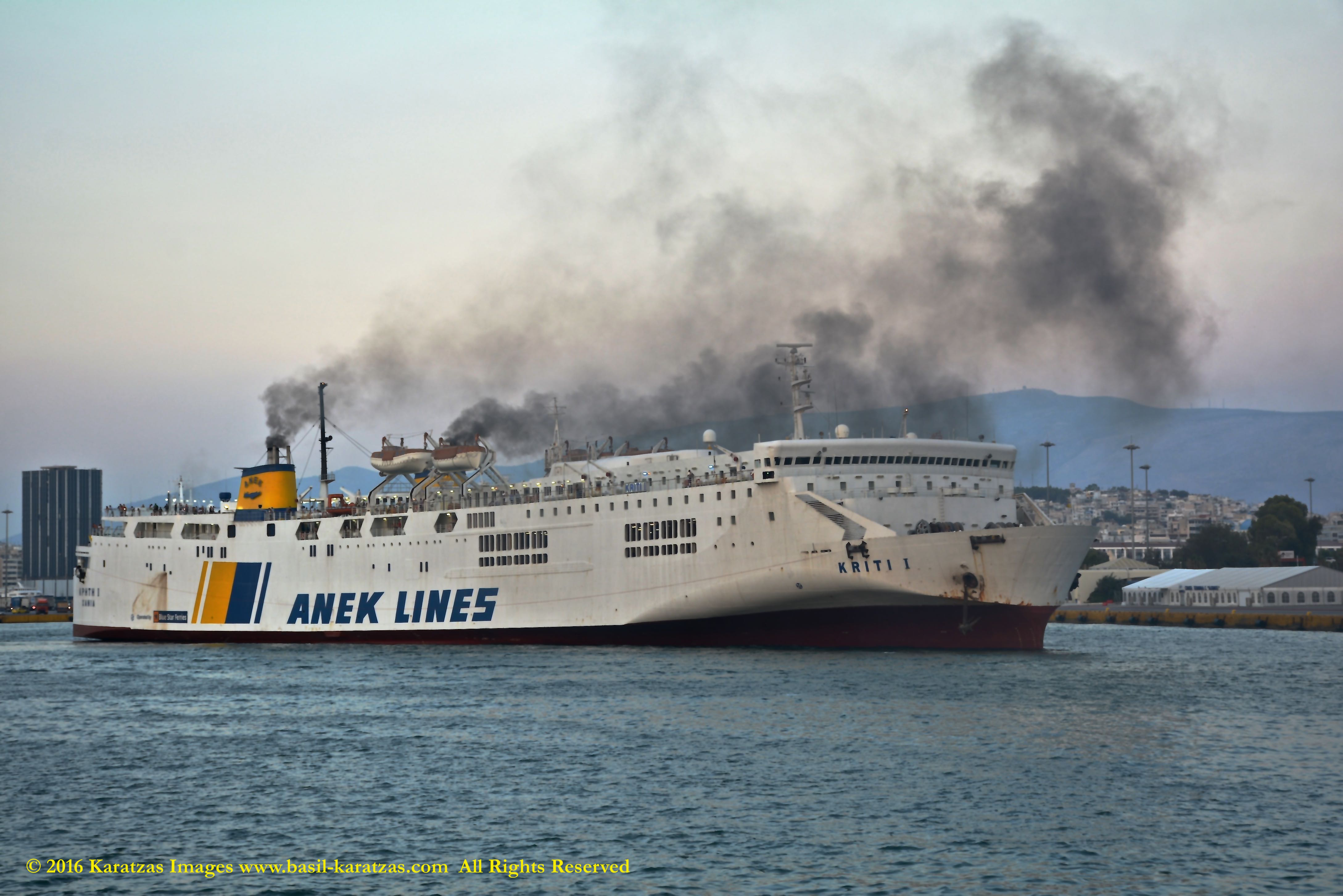
All the SOx and Nox and COx of the world… Not a day too soon for the IMO to act. Image credit: Karatzas Images


© 2013-2015 Basil M Karatzas & Karatzas Marine Advisors & Co.  All Rights Reserved.

IMPORTANT DISCLAIMER:  Access to this blog signifies the reader’s irrevocable acceptance of this disclaimer. No part of this blog can be reproduced by any means and under any circumstances, whatsoever, in whole or in part, without proper attribution or the consent of the copyright and trademark holders of this website.Whilst every effort has been made to ensure that information herewithin has been received from sources believed to be reliable and such information is believed to be accurate at the time of publishing, no warranties or assurances whatsoever are made in reference to accuracy or completeness of said information, and no liability whatsoever will be accepted for taking or failing to take any action upon any information contained in any part of this website.  Thank you for the consideration.

Save

Save

Tanker Sale & Purchase (S&P) Update

In an effort to be more efficient and focused, from now we will report on this blog only pertinent transactions per market segment and asset class for s&p (sale & purchase market) that have occurred in the last couple of weeks. Transactions and transaction details in shipping are never as transparent and clear-cut as many an analyst or an appraiser may wish to think; having the benefit of time-lapse and fact-checking, we believe that reporting more accurately sales vs reporting them prompter is of greater service to our readership. Also, our reporting will be more structured by market segment and asset class going forward. Transactions will be purely reported herewith; commentary on market conditions and trends, discussion on transactions and developments and their significance will be posted at our sistership blog, Shipping Finance by Karatzas Marine.

Please feel free to subscribe!

As always, shipbrokerage and shipping finance advisory is provide by our sponsor company, Karatzas Marine Advisors & Co.


Despite the softening of tanker freight rates in the last two weeks, one has to be humbly impressed by the performance of the tanker sector over the last twelve months, and accept that volatility in the shipping industry is hard to accurately model: VLCC spot rates (the group most volatile but with the easiest-models-to-build of the tanker market) have moved from $33,000 pd this time last year to above the $60,000 pd mark on several occasions in January, March and May this year, flirted teasingly with the $90,000 pd mark three weeks ago, and now have come full circle to appr. $34,000 pd. It has been a great market of sorts, definitely in comparative terms to dry bulk and containership markets, but still, some people have been worrying whether the structural recovery of the sector is still intact: the demolition pace has slowed down, newbuilding activity has increased, but still the time lapse of the deliveries (about a two-year-delay) does not seem to provide much comfort or confidence: tanker stock prices have not outperformed the broad market, to put it liberally, and most of the tanker stocks trade barely at or below NAV at the very best (the implied valuation of their tankers-on-the-water), while tanker IPO hopefuls waiting in the wings, and waiting… and tanker vessel prices really have not justified the buy-low-sell-high asset play strategy of many a shipowner.

The sale and purchase market has quieted down in the last two weeks, partially due to peak vacation season and also due to the chilling effect of a deflating tanker freight market. Besides the rather un-inspiring prices achieved, several of the sales have been controlled by financial investors, including private equity funds. The involvement of private equity funds with shipping has drawn much attention and we have written on the topic in the past; however, seeing York Capital, Wayzata Investments and Apollo, among others, selling vessels – and not shares at IPOs as per original game plan, and sales of vessels in a ‘hot’ market and at prices that do not seem to come remotely close to highly advertised double-digit expected returns of the private equity…but again, barely a week passes with funds folding due to poor performance because of commodities, currencies, emerging markets…at least, shipping has not sunk a fund yet, at least formally.

In the VLCC market, Tufton Oceanic has disposed of MT ‘Sasa’ (300,000 dwt, Hitachi Zosen, 2001) at $40.5 mil to Russian buyers, while Windsor Petroleum has sold to US-based Ridgebury Tankers four sistership vessels at a value-oriented price of $150 mil for the package: MT ‘British Purpose’, MT ‘Progress’, MT ‘Pride’ and MT ‘Pioneer’ (all ca. 305,000 dwt, Samsung Heavy Industries, 2000/2000/2000/1999).

MT PRINCIMAR AMERICAS 10

House-flag in the news… Karatzas Photographie Maritime

The Suezmax market has been more active in the last month, reflecting a more fragmented market but also a stronger freight market. The transaction that stood out was the sale of the Veritable fleet by Principal Maritime, which had been sponsored and funded by Apollo; one set of six sisterships built at Samsung Heavy Industries MT ‘Princimar Courage’, MT ‘Princimar Pride’, MT ‘Princimar Integrity’, MT ‘Princimar Grace’, MT ‘Princimar Hope’ and MT ‘Princimar Promise’ (158,000 dwt, Samsung H.I., 2013 / 2012 / 2012 / 2011 / 2011 / 2011, respectively), one set of two-chinese sisterships built in 2010, MT ‘Princimar Joy’ and MT ‘Princimar Strength’ (156,000, Rongsheng, 2010), one set of Japanese built sisterships MT ‘Princimar Confidence’ and MT ‘Princimar Loyalty’ (150,000 dwt, Universal, 2006) and two one-off Korean vessels, MT ‘Princimar Truth’ (160,000 dwt, Hyundai Samho, 2007) and MT ‘Princimar Faith’ (160,000, Daewoo (DSME), 2005) at $662 mil, with payment mostly in cash but also $50 mil in stock. There are several angles to see this transaction since it is estimated that the sellers realized more than $100 mil loss from the sale (estimated cost basis of ca. $770 mil), and also that the sale price was NOT the highest in this auction-like sale transaction. The company has attempted for an IPO late last year but there was not sufficient demand / pricing to proceed then, but it’s to be debated whether demand would had been enough for an IPO now in an allegedly much stronger market, at least as much as freight is concerned. Russian tanker company Sovcomflot has sold their 2003-built Suezmax tanker MT ‘SCF Valdai’ (159,000 dwt, Hyundai Heavy, 2003) to Greek buyers at $35.5 mil. Vintage Suezmax tanker MT ‘Front Glory’ (149,500 dwt, Mitsui Shipbuilding, 1995) was sold by the Fredrisken Group to Far East buyers at $16 mil, almost twice her present scrap value (21,733 ldt). Similarly aged Suezmax tankers (with shuttle-tanker conversion) MT ‘Mattea’ (127,000 dwt, Samsung Heavy, 1997) was sold at $11 mil to undisclosed buyers, rumored Greeks, and MT ‘Kometik’ (126,500 dwt, Samsung Heavy, 1997) was sold at $8 mil to Andromeda Shipping in Monaco. Sisterships MT ‘Cape Bata’ and MT ‘Cape Bowen’ (160,000 dwt, Samsung Heavy, 2003) were sold by KG-funds in Germany to Tufton Oceanic in the UK at appr. $33 mil, each.

MT CAPE BRASILIA 4

A calm tanker market… Karatzas Photographie Maritime.

The aframax tanker market has been rather subdued with the exception of a financial transaction for eight coated LR2 tankers by Navig8 to Chinese buyers at $300 mil; given that there is bareboat back for ten years to sellers / Navig8 little can be said for the below-market ‘sale price’ which can be attributed to the Chinese pedigree of the vessels or Navig8’s persisting rumors abut being able to fund their capex gap for their newbuilding program; vessels were: N/B CSSC Offshore Marine Guangzhou H-057 to H-061 and Hulls H-067 and H-068 (112,000 dwt, CSSC Offshore Marine Guangzhou, 2016/2017); vessels names are MT ‘Navig Gallantry’, MT ‘Navig8 Gauntlet’, MT ’Navig8 Goal’, MT ‘Navig8 Grace’, MT ‘Navig8 Gratitude’, MT ‘Navig8 Guard’, MT ‘Navig8 Guide’ and MT ‘Navig8 Gladiator’. Buyers / lessors are affiliated with the shipbuilding group.

In the MR2 tanker market, a couple of interesting transaction with sellers based in the landlocked Upper Midwest in the USA: Wayzata Investment Partners have sold two product tankers MT ‘Halstead Bay’ (51,000 dwt, SLS Shipbuilding, 2007) at $23 million and MT ‘Maxwell Bay’ (51,000, Guangzhou SY Intl, 2013) at $30 mil, to Torm in Denmark. CarVal Investors have sold sisterships MT ‘Harbour Star’ and MT ‘Super Star’ (51,000 dwt, STX SB (Jinhae), 2008) to Target Marine in Greece at $24.5 mil, each. Tankerska Next Generation has sold two 2015 resales at SPP at $38.5 mil, each to Cardiff Marine in Greece (SPP Hull 079/080, SPP, 2015). York Capital in the US has sold their interest in Hyundai Mipo Hull 2473 (51,000 dwt, HMD, 2015) at $37.5 mil to Scorpio Tankers. Finally, Eletson Corporation of Greece has sold vintage tankers MT ‘Kandilousa’ and MT ‘Serifos’ (46,700 dwt, HHI, 1995) at $8.5 mil.

Overall, the market has not been as busy as it seems with most of the transactions being of ‘corporate’ matters instead of the traditional s&p (sale & purchase). Whether there is no strong conviction from operating buyers to step up on buying or lack of capital constrain their buying appetite, financial players seem to be getting ever more obvious; not as much as with buying, but selling is welcome news as well.


© 2013-2015 Basil M Karatzas & Karatzas Marine Advisors & Co.  All Rights Reserved.

IMPORTANT DISCLAIMER:  Access to this blog signifies the reader’s irrevocable acceptance of this disclaimer. No part of this blog can be reproduced by any means and under any circumstances, whatsoever, in whole or in part, without proper attribution or the consent of the copyright and trademark holders of this website.Whilst every effort has been made to ensure that information herewithin has been received from sources believed to be reliable and such information is believed to be accurate at the time of publishing, no warranties or assurances whatsoever are made in reference to accuracy or completeness of said information, and no liability whatsoever will be accepted for taking or failing to take any action upon any information contained in any part of this website.  Thank you for the consideration.


S&P, Newbuilding and Demolition Update (March 22th, 2015) – Dry Bulk Market Focus

The last couple of weeks have brought the slimmest hope that springtime may be forthcoming for the much beleaguered dry bulk market; we are not talking about signs of an impending great recovery, but at least the dry bulk indices have stopped dropping and have shown marginal improvement; the widely-observed Baltic Dry Index (BDI) established an all-time low point on February 18th at 509 and closed at 591 on Friday March 20th; on percentage terms the improvement seems impressive (close to 20%), but again one has to keep in mind that the low of 509 was a thirty-year low – almost, and despite the improvement, dry bulk vessels are earnings below cash break even rates – thus, the improvement is not financially meaningful; it only bears psychological significance that hopefully the worst is behind us, for now.

As one would expect, publicly listed dry bulk companies continue to report abysmal earnings (actually losses), and earnings conference calls tend to range from confessionary litanies to Christmas lists on what would turn the market around. There have been the occasional corporate bankruptcy here and there and some ship arrests on a limited basis but nothing of a Korea Line Company (KLC) magnitude shockwave. Likely another blowup the size and significance of KLC will not materialize in the dry bulk market as KLC had taken shiploads on vessels at sky-high rates prior to 2008 while most of the traders / charter-in operators today have established their cost floors and rates at substantially lower rates in 2012 to 2014.

MV STAR EPSILON 2

Supramax Bulker ‘Star Epsilon’ passing the Statue of Liberty in the New York Harbor; image source: Karatzas Photographie Maritime

While the dry bulk handysize, supramax and to a lesser extent panamaxes were slowly improving for a couple of weeks now, capesize vessels are kept on a freight declining route; only this week capes bounced from a low of 357 points to 423 points in a matter of two days, generating suspense for the coming week whether the freight rates will keep moving higher. It may be so, and it will be most welcome news; however, over the longer term, capesize tonnage likely will have a tough ride: the Chinese economy has both been slowing down and also getting shifted from industrial production to consumption which does not bode well for iron ore imports and the cape market; further, China has been producing (and storing) much more steel that can use and recently there have been talks of China dumping below cost steel to the international markets raising the prospects that the World Trade Organization (WTO) may be asked to look into the complaints; the fact that mining companies have been building up their own captive fleets and that Vale managed to find a resolution with China and Cosco for their so-called Valemax fleet is not boding well for the overall capesize market and the independent owners. A boost to the capesize market is much needed and hoped for, but on the long term, one has to be skeptical of too rosy prospects.

In terms of sale & purchase activity in the dry bulk markets, at present, actual activity is low; there is lots of ‘browsing’ and ‘interest‘ for buying quality vessels but little of such interest is translated to actual transactions; buyers are trying to find a ‘balance’ of not buying too early when bulkers can further drop in pricing, but, on the other hand, they do not want to miss out when the market recovers; it seems a patience search of the absolute bottom in asset prices is the name of the game. Few transactions can be reported in the dry bulk market and mostly for small, older, cheaper vessels (in absolute terms); given the lack of benchmark transactions is hard to place an accurate estimate of asset price decline; however, the trend is apparent that based on the transactions reported the market keeps heading lower.

In the capesize market, the sale of MV „Cape Stork” (171,000 dwt, IHI, 1996) was reportedly at close to $7.8 mil, a scrap related price level; interestingly, the vessel was sold in November 2014, less than six months ago, at excess of $15 mil, implying that the buyers’ bet then on a seasonal recovery for capes during the holiday season has not played out as expected. In another interesting transaction in the sector, Oaktree has sold at $80 million apiece two VLOCs MV „Selma B“ and MV „Camilla T” (320,000 dwt, HHI, 2010/ 2011, respectively) to Olympic Shipping (Onassis Group) to be converted to VLCCs; Oaktree was involved with the vessels during the restructuring of Nobu Su’s TMT (Today Makes Tomorrow); during the last year, the Onassis Group has shown to be an active buyer of tonnage, primarily in their historically beloved tanker market; however, the pricing for these vessels seems to be too strong given the costs, risks and ‘hair’ involved for the conversion project, not mentioning the concern that typically converted vessels do not seem to get special attention for the remaining of their trading lives by the charter market.

In the panamax bulker market, the post-panamax bulker vessel specialized for the coal trade MV „Sekiyo” (91,500 dwt, Hitachi, 1998) was sold at close to $9 million to Chinese buyers by Nippon Yusen Kaisha (N.Y.K. Line); the price is at premium of a couple million to scrap pricing, which is the norm these days for tonnage built prior to 2000. In the same sector, MV „Lopi Z” (72,000 dwt, Shin Kurushima, 1998) was sold to Norwegian investors in a sale-and-lease back transaction from Dalomar Shipping in Greece at approximately $6 mil, a purely scrap related price.

MV BULK COLOMBIA 12

Supramax Bulker ‘Bulk Colombia’ in the Port of Hamburg; image source: Karatzas Photographie Maritime

The supramax market has proven the most active in the dry bulk market, with the sale of MV „C.S. Rainbow” (55,700 dwt, Mitsui, 2006, 4x30T cranes) at $11.25 mil by Japanese sellers to Greeks buyers (Blue Seas). The sale seems to be well below the price achieved by same sellers of similar vessel MV „Sunny Ace” (55,800 dwt, Kawasaki, 2005, 4x30T cranes) at $11.3 mil one month ago (vessel was also SSDD due.) Looking further back in January, when MV „VERDI” (2007, 58,500 DWT, Tsuneishi Zhoushan) was sold at $15 mil, the trend in supramax bulker pricing is clear. It’s really very hard to comprehend that ten-year-old supramaxes were selling at more than $60 mil in the spring of 2008 and at $22 mil just one short year ago; now we are talking about $10 – $11 mil for a ten-year-old vessel. The ten-year-old handymax MV „Ramada Queen” (46,000 dwt, Oshima, 2005) with drydock due sold at an eye-popping price of $8.7 mil to Greek buyers (Primal). The older handymax MV „Valopoula” (45,500 dwt, Tsuneishi Cebu, 2000, 4x30T) was sold at a respectable but still scrap related pricing of $6.1 mil to Greek buyers again (Dianik Shipping) with drydosck due. The smaller and meaningfully older handymax MV „Bay Ranger” (43,500 dwt, Oshima, 1995, 5x25T cranes) was sold at appr. $4.5 mil with the vessel recently having been drydocked (present estimated scrap value of about $3.1 mil at 7,350 ldt.) The similar vessel MV „Hellenic Horizon” (44,800 dwt, Halla, 1995), 4x25T cranes) was sold at a scrap related $3.7 mil – with drydock promptly due.

As one can note, recent transactions in the dry bulk sale & purchase market resemble rather a scrap report, with vessels sold between 10-20 years old and no modern tonnage to report on, drydock position and estimated scrap price always as points of reference. And the prices achieved resemble prices for vessels selling for scrap rather than further trading, another indication that buyers opt to act only when there is little downside risk with their acquisitions, either with vessels with 5+ years of trading life at scrap pricings on a minimal pricing over scrap and drydocking for vessels having a decent survey position.

Can things get more difficult?


© 2013-2015 Basil M Karatzas & Karatzas Marine Advisors & Co.  All Rights Reserved.

IMPORTANT DISCLAIMER:  Access to this blog signifies the reader’s irrevocable acceptance of this disclaimer. No part of this blog can be reproduced by any means and under any circumstances, whatsoever, in whole or in part, without proper attribution or the consent of the copyright and trademark holders of this website.Whilst every effort has been made to ensure that information herewithin has been received from sources believed to be reliable and such information is believed to be accurate at the time of publishing, no warranties or assurances whatsoever are made in reference to accuracy or completeness of said information, and no liability whatsoever will be accepted for taking or failing to take any action upon any information contained in any part of this website.  Thank you for the consideration.

S&P, Newbuilding and Demolition Update (March 8th, 2015) – Tanker Market Focus

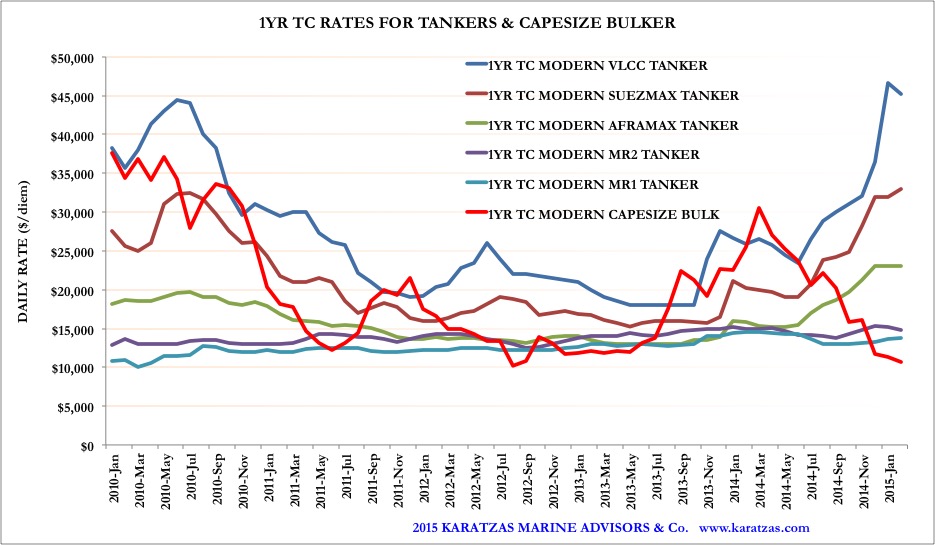
Unlike the dry bulk market which is experiencing a multi-cycle structural weakness, the tanker market has been behaving much more enthusiastically, at least for time being. Tanker vessels have been trading above operating earnings since early 2014, and on occasion, for spot rates, earnings have been eye-popping – such as when in January 2015 rates for VLCCs flirted with the $100,000 pd mark. The attached graph shows one-year time-charter rates for the major segments in the tanker market, including the capesize market, for purposes of illustration and comparing tanker and dry bulker markets; and an obvious reminder, capesize vessels are the largest commoditized bulker vessels in the business.

2015 03MAR08 Sale&Purchase Tanker Market Update_Graph TC Rates

Crude oil pricing has grossly halved in the last year, and OPEC’s (read, Saudi Arabia’s) decision in November in Vienna to go after market share rather than margins has ensured that at least in the short term, oil will be cheap and likely will be trading heavily. Cheaper crude oil pricing has the potential of contango (buy now in the physical market, store – ideally on tankers – and sell in the futures market at a higher price); cheap oil pricing has the prospect of increasing demand (there are already signs that sales of SUVs and trucks are on the up in the USA) that eventually will mean more movement of cargoes; cheap crude oil has been encouraging build up of strategic petroleum reserves, and there are indications that China is going strong at building up theirs under the weakness of the pricing of the commodity. A brutal winter in the USA has stimulated the use of gasoline which has affected positively the petroleum products trade in the Atlantic. Despite the shutting down of many drills in the US for shale oil production (down by 39% from 1609 to 986 operating drilling rigs between October and end of February, according to Baker Hughes), the US maintains sky high inventories of WTI crude oil (for the week ended on February 27th, US crude oil inventories showed a massive weekly build-up of 10.3 million barrels to a total of 444.4 million barrels); if not for the shale oil production, the seasonal impact of the inhumane winter would have a much pronounced impact on the crude oil tanker market.

The strength of the tanker freight market has stimulated increased dealing in the sale & purchase market, but mostly it has encouraged several ‘corporate’ transactions whether on the M&A front (Euronav acquiring the Maersk VLCC fleet, the ‘merger’ of the Navig8 VLCC fleet with General Maritime to create Gener8, DHT’s acquisition of Samco Shipholding’s VLCC fleet) and on the IPO front (earlier this year Euronav was successful finally obtaining a public listing in the US). While more M&A in the tanker market may be expected, IPOs can be a trickier market, as investor appetite can gyrate faster than the fortunes for freight for big tankers. There is increased interest to see how a few of PE-sponsored tanker shipping companies will proceed in this environment, which while promising, it does not allow for these companies to float at a profit – indicatively, both Diamond S. sponsored by Wilbur Ross and Principal Maritime sponsored by Apollo – have relatively high cost basis and a floating at NAV will result in realizing losses, at least in the short term. Investor interest, and also charterer interest, in the tanker market – despite the market’s strength – have been of concern to many a shipowner. For instance, while the spot market is very respectable, there is no period market – in general – as charterers prefer to pay up spot prices now but not willing to commit for a two-year charter. This observation does not bode well for the future of the market, when charterers do not have the conviction to commit for two years of rates – in hot markets or markets expected to break out, charterers want to act and cap their exposure.

Likewise, the activity in the secondary market has not been as active as the freight market would suggest; of course, banks do not lend easily these days, thus this is a dislocation affecting overall activity in the market. And the freight market is not as strong to support modern tonnage for operating expenses (OpEx) and a fully amortizing loans; by revisiting out graph at the top of the page, one-year TC for a modern VLCC is appr. $45,000 pd; given a nominal price of a VLCC tanker of approx. $100 mil. and approx. $9,000 pd OpEx, the earnings barely cover a fully amortizing ship mortgage. And, sale and purchase activity has overall been anemic – despite the strength of the market; and it’s clear that the focus of the transactions has been concentrated on modern vessels [typically vessels newer than five years old – suitable for publicly traded companies that are ‘hot’ for deals in this market and pay with equity (thus low leverage / more flexibility with cash flows), and vessels older than twelve years old at often prices at a multiple of scrap – by Asian buyers or buyers with access to cargoes]; these typically are not signs of a very liquid, solid market that has consolidated and about to break out; not to mention, that now that the freight market has improved, there have been packages of very modern tanker tonnage discreetly mentioned for sale, primarily from ‘OK’ owners or ‘OK’ / Chinese yards who are testing the market to offload positions at a small loss or at a break-even; once again, an indication of little faith in the prospects of the market, albeit from ‘weak hands’ or ‘OK’ quality tonnage with little prospects to be much sought after in the future.

On indicative purposes, since the beginning of the year, the following representative transactions have taken place: in the VLCC market, MT „Patris” (298,500 DWT, Daewoo, 2000) was sold by Chandris (Hellas) in the UK to clients for Modec for FPSO conversion at the relatively very strong price of $38 million; similar vessel, MT „GC Haiku” (299,000 DWT, Hitachi Zosen, 2000) was sold at $31 million by GC Tankers to New Shipping; the three-year newer MT „DS Voyager” (309,000 DWT, Samsung HI, 2003) was sold by DS Tankers to NG Moundreas in Greece at $42 million.

In the Suezmax tanker market, in 2015 so far, there has been only the sale of two sistership vessels MT „Chapter Genta” (156,000 DWT, Jiangsu Rongsheng, 2010) and MT „Roxen Star” (156,000 DWT, Jiangsu Rongsheng, 2009) at $96 mil from Roxen Shipping to interests controlled by Frontline / Fredriksen Group.

Likewise in the aframax tankers, Teekay Offshore has disposed of the shuttle tanker MT „Navion Svenita” (106,500 DWT, Koyo Dock, 1997) at an undisclosed price; MT „Sark” (113,000 DWT, New Times SB, 2009) has been sold by Sark Shipping to EA Technique at $40 million.

In the LR1 tanker market, Prime Marine of Greece has sold four LR1 tankers to Hafnia Tankers in Denmark at an undisclosed consideration; the vessels were MT „Arctic Char” (75,000 DWT, Brodosplit, 2010) and the sisterships MT „Karei”, MT „Kihada” and MT „Maguro” (74,250 DWT, STX SC (Jinhue) 2010).

The MR2 product tanker market has been more active with the sale of sistership tankers MT „Caletta” and MT „Calafuria” (51,500 DWT, Hyundai Mipo, 2011 / 2010, respectively) by G. D’Alesio in Italy to interests at $30 mil each. For pumproom design vessels, Minerva Marine of Greece acquired MT „Nord Obtainer” (47,500 DWT, Onomichi Dockyard, 2008) at $19.50 mil, while similar tonnage vessel was sold to clients of Benetech in Greece at the comparatively high price of $23 mil for MT „Nord Star” (45,900 DWT, Shin Kurushima, 2009) from Saito Kisen. MT „Hellas Symphony” (46,200 DWT, Hyundai Heavy, 2000) was sold by clients of Latsco in the UK at $10.5 million, while similar tonnage MT „Tosca” (47,500 DWT, Brod. Trogir, 2004) was sold at $18 million. The 1997-built tanker MT „Midnight Sun” (45,000 DWT, Minami Nippon, 1997) was sold from Mitsui OSK Lines in Japan at $8.0 million to Far Eastern interests.

There has been an interesting sale of an MR1 tanker, MT „HC Elida” (37,500 DWT, Hyundai, 2001) at $11.5 million by Marlink Shif. in Germany to Far Eastern interests, showing relative strength for this under-the-radar tanker segment.

There have also been a few transactions in the usually quiet market for stainless steel tankers, such as the sale of MT „HF Pioneer” (19,900 DWT, Fukuoka SB, 2010) by Fairfield Chemical in the US to clients of Heung-A at $25.25 million. The also stainless steel tanker MT „Fairchem Colt” (19,900 DWT, Usuki Zosensho, 2005) by Tanba Kisen to S. Korean interests at $19 million. The older stainless steel tanker MT „ST Dawn” (19,900 DWT, Shin Kurushima, 2000) was sold by Stalwart Tankers at $14.5 mil to clients of TPL Shipping. The IMO II/III epoxy-coated tanker MT „Sichem Onomichi” (13,000 DWT, Sekwang, 2008) was sold at $11 million by Hisafuku Kisen K.K to S. Korean interests.

Once again, despite the fairly encouraging freight market, rather few transactions have taken place in the secondary market for tankers, and mostly for tonnage either newer than five years or older than twelve years.

And keeping accounts for newbuildings, eleven VLCC tankers have been ordered in 2015, twelve orders for Suezmax tankers and fifteen orders for Aframax tankers, and four MR tankers have been placed. All in all, TWO WHOLE VLCCs were scrapped so far this year, and zero scrappings in the rest of the tanker segments mentioned in this report, for a NET GROWTH of the world tanker fleet. It seems that staying away from NBs and more orders for tonnage is hard to do… And, a quick remark on the demolition market that has dropped by 20-25% since the beginning of the year, given the weakness of the dry bulk market and plenty of vessels offered, thus driving supply up and prices lower, admittedly from speculative rates well in excess of $500/ldt at the beginning of this year.


© 2013-2015 Basil M Karatzas & Karatzas Marine Advisors & Co.  All Rights Reserved.

IMPORTANT DISCLAIMER:  Access to this blog signifies the reader’s irrevocable acceptance of this disclaimer. No part of this blog can be reproduced by any means and under any circumstances, whatsoever, in whole or in part, without proper attribution or the consent of the copyright and trademark holders of this website.Whilst every effort has been made to ensure that information herewithin has been received from sources believed to be reliable and such information is believed to be accurate at the time of publishing, no warranties or assurances whatsoever are made in reference to accuracy or completeness of said information, and no liability whatsoever will be accepted for taking or failing to take any action upon any information contained in any part of this website.  Thank you for the consideration.